Nutraceutical Ingredient Supplier – The development of high performance dietary supplements, functional food and sports nutrition products depend on the availability of raw materials with consistent bio-activity, proven purity and total batch stability. One spoiled lot or miscompliance can stop production, lose consumer confidence and cause expensive product recalls. One of the most critical technical relationships is choosing the right Nutraceutical Ingredient Supplier that determines the viability of your brand.
With increasing regulatory pressure around the world and consumer expectations for total clean-label data, procurement managers have to assess potential supply partners based on strict technical requirements. Today, we will uncover the major aspects to consider when selecting a supply partner, backed by the latest market data and technical standards for sourcing.
The Global Nutraceutical Landscape: Growth, Trends, and Market Data
The world is moving towards a more preventive approach to health, managing chronic diseases, and enabling active healthy lifestyles, driving product sales in both the supplement and functional food categories. Market research data shows that the global nutraceutical ingredients industry grew to more than USD 100 Billion in value during the past five years, and is projected to grow at a compound annual growth rate (CAGR) of 7.8%.
Asia-Pacific has the largest share of global raw materials production, with India becoming a significant raw material supplier for high purity botanical extracts, active enzymes and specialty bio-actives. Thousands of suppliers are competing, though, and product managers are dealing with huge variations in quality. When deciding on a Nutraceutical Ingredient Supplier, it is important to conduct comprehensive review of technical specifications, laboratory testing procedures and compliance documentation.
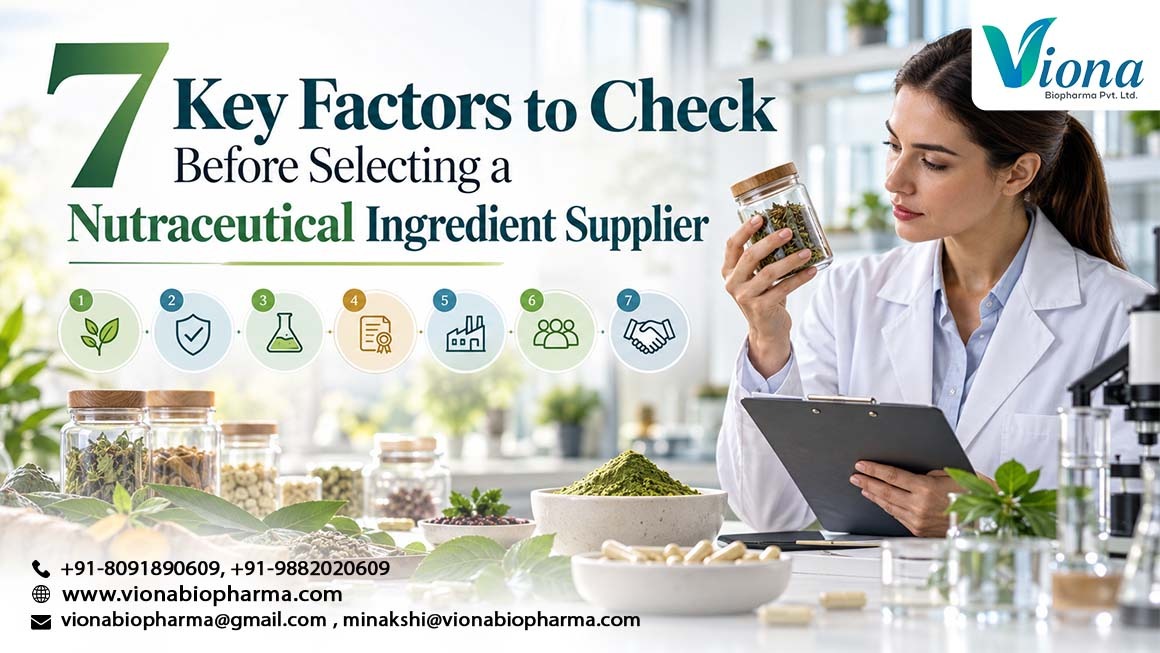
7 Key Factors to Evaluate Before Selecting a Supplier
1. Regulatory Compliance & Quality Certifications
A reputable supplier should have important certifications such as WHO-GMP, ISO 22000, cGMP and have been registered with FSSAI, or US FDA. With these qualifications on hand, you can be sure your products are safe and won’t face any unnecessary delays in customs.
2. Analytical Transparency & COA Accuracy
Do not accept bulk shipments, if there is no batch documentation. A trusted nutraceutical ingredient supplier offers Certificate of Analysis with active potency assays (HPLC/UV), heavy metal limits and microbiological screens.
3. Product Portfolio Versatility
Having multiple suppliers, results in higher overheads. Consider suppliers that have a variety of catalogues, such as specialising in liposomal ingredients for nutraceuticals, a pharma-grade supply of enzymes from an established Indian supplier and plant-based alternatives like vegan D3 sourced from lichen.
| Key Ingredient Category | Essential Testing & Spec Focus |
| Enzymes & Probiotics | Activity units (FCC/FIP), CFU count, and thermal stability. |
| Bio-Actives & Liposomes | Particle size distribution, active assay percentage and absorption. |
| Specialty Collagens | Native triple-helix preservation, protein assay, and heavy metal purity. |
4. Traceability & Scientific Validation
The top vendors have backward traceability from harvesting to the final dispatch. If you look at technical data on collagen type 2 explained, you’ll see that it’s different when used in its intact triple-helix structure as compared to the standard hydrolyzed peptides.
5. Cold-Chain Storage & Supply Security
Enzymes and probiotics are heat sensitive. Assess your supplier’s warehousing system for adequate automated climate control, thermal packaging and buffer inventory systems.
6. Spec-Matched Bio-Actives
The general specifications are often not enough for specific formulations. When purchasing joint-support materials, it is important to work with certified collagen raw material supplier that can supply native Undenatured Type II Collagen to ensure the correct bulk density and mesh size are achieved during manufacturing.
7. R&D & Technical Collaboration
Choose an ingredient partner whose technical team offers formulation guidance, custom micronization, excipient advice, and regulatory dossier support.
Partnering with Viona Biopharma for Premium Ingredients
The first step to a successful supplement brand is to obtain the raw materials that meet purity and compliance standards. Viona Biopharma offers a wide range of highly pure nutraceutical ingredients such as native undenatured collagens, liposomal collagens, pharma grade enzymes, probiotics, and plant bio-actives. In addition to our multi-stage quality testing process, our climate controlled warehousing and complete regulatory transparency, we are a trusted Nutraceutical Ingredient Supplier for healthcare and nutrition brands around the globe. Talk to us today and get the raw materials you need for your next formulation – verified for export!
FAQs
Q1: What is difference between COA, and Technical Data Sheet?
Ans: A TDS provides general information about the properties of a product, whereas a COA is a test report of the purity, potency and safety results for a specific batch of product.
Q2: What is the advantage of liposomal ingredients over regular powdered ingredients?
Ans: Enclosed in liposomes, active nutrients are highly protected from stomach acid and are very well absorbed in finished products.
Q3: What are the storage requirement for nutraceutical enzymes and probiotics?
Ans: Delicate enzymes and living probiotics must be stored at a controlled humidity and at climate-controlled temperatures (usually below 25°C or 2°C–8°C).