The active nutrition landscape is experiencing a structural pivot. The formulation scientists, procurement directors and brand developers are working actively to replace raw materials of animal origin with plant-based activities. In today’s global market, traditional Vitamin D3 (lanolin from sheep’s wool) is being replaced by Cholecalciferol derived from sustainable lichen sources to comply with strict clean label, vegan and allergen-free requirements.
India has established itself as an important manufacturing hub for non-animal bio-actives. While sourcing Vegan Vitamin D3, it is critical to identify suppliers with proven testing procedures, and regulatory documentation and a reliable commercial scale.
What Is Vegan Vitamin D3?
It is a 100% plant-sourced active ingredient chemically identical to human-synthesized D3 (C₂₇H₄₄O). Traditional D3 is obtained from lanolin that has been scraped off from the wool of sheep.
Vegan D3 is derived from a natural wild or cultivated lichen—a symbiotic combination of fungi and algae. Lichen-derived D3 has a high bio-identity to human Cholecalciferol, meaning that it has high biological potency and serum absorption rate compared to conventional D3, and it does not contain animal based carriers and cross-contaminants.
Core Health Uses
|
Commercial Product Uses
|
How Lichen-Derived Vitamin D3 Is Produced
When exposed to natural ultraviolet light, lichens produce an active form of Cholecalciferol. The process to convert raw source of biomass to a standardized commercial-grade active ingredient can be broken down into five stages:
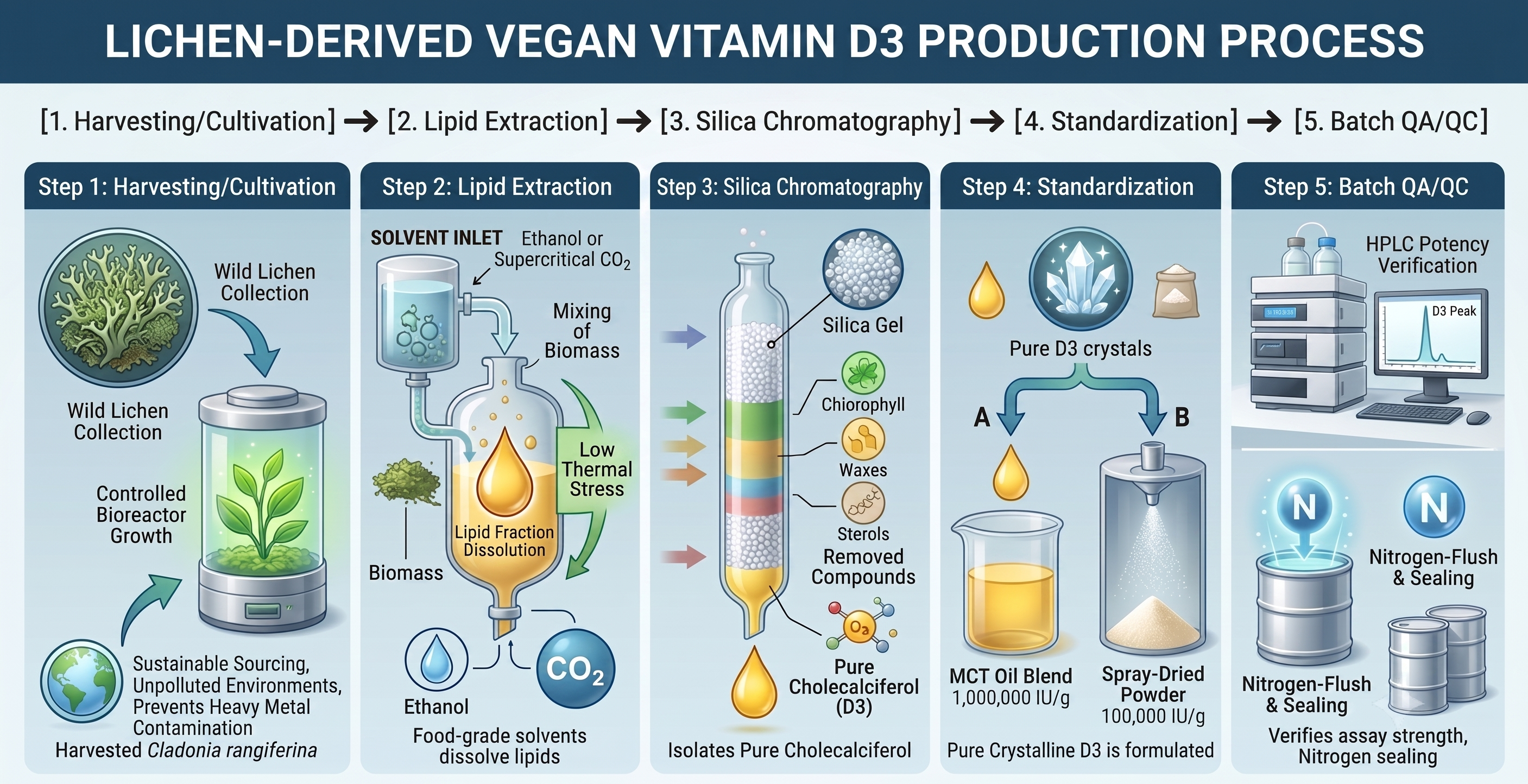
- Step 1: Harvesting/Cultivation: The wild lichen (Cladonia rangiferina) is harvested from the natural habitat or cultivated in a controlled indoor bioreactor to avoid heavy metal contamination.
- Step 2: Lipid Extraction: The use of food grade ethanol or supercritical carbon dioxide (CO₂) extracts lipid fractions without exposing the material to excessive heat.
- Step 3: Silica Chromatography: Pure Cholecalciferol is isolated from plant chlorophyll, waxes and sterols by multi-stage silica column chromatography.
- Step 4: Standardisation: Pure crystalline D3 is added to medium-chain triglyceride (MCT) oil (1,000,000 IU/g) or to cold water dispersible powder (100,000 IU/g).
- Step 5: Batch QA/QC: Active assay strength is checked by a High-Performance Liquid Chromatography (HPLC) prior to nitrogen flush, and sealing in the food-grade aluminum packaging.
Key Criteria for Evaluating Indian Suppliers
| Evaluation Criteria | Key Verification Requirements | Standard Thresholds & Certifications |
| Analytical Verification | Certificate of Analysis, HPLC assay results, microbial clearance | Pb < 3.0 ppm, As < 1.0 ppm, Cd < 1.0 ppm, Hg < 0.1 ppm |
| Regulatory Accreditation | Facility compliance and non-animal sourcing standards | cGMP, ISO 22000, WHO-GMP, FSSAI, Non-GMO Project, Vegan Society |
| Stability & Overage Data | Accelerated and real-time stability testing studies | 10% – 15% overage for 100% label claim retention |
Leading Suppliers of Vegan Vitamin D3 in India
1. Viona Biopharma
Viona supplies commercial-scale Vegan D3 raw materials derived directly from lichen. The company offers 100,000 IU/g CWD powders and 1,000,000 IU/g MCT oil solutions specifically designed to be stable in tablets, capsules, liquids, and gummies.
They have a portfolio of active ingredients including Bio-Actives, Amino Acids (in pharmacologic grade), Liposomal Ingredients (high absorption) and joint health ingredients such as Smarticol Undenatured Type II Collagen.
2. Botanical Extract Manufacturers
Standardized botanical activities such as Green Tea Extract and Curcumin Extract are processed together with plant-based vitamins by Indian extraction facilities situated throughout the several industrial hubs in Gujarat, Maharashtra and South India.
3. Integrated Premix Blenders
Custom nutrient blenders are made of lichen-derived D3 along with complementary bio-actives. Since plant D3 is often combined with Algal DHA Oil or systemic enzymes such as Nattokinase, plant D3s are commonly formulated into specific multi-nutrient products for bone, joint and cardiovascular health.
Conclusion
When it comes to sourcing lichen-derived Vegan Vitamin D3, it is important to check the supplier credentials, including HPLC analytical testing, international certification and material stability. Direct relationships with qualified Indian manufacturers ensure supply chain resilience, total regulatory support and assured lanolin-free active ingredients for global distribution of brands.
For commercial pricing, technical spec sheets or pre-shipment lab samples of Vegan D3, please reach out to Viona Biopharma through Contact Us or through technical formulation guides of Liposomal Nutraceutical Ingredients.
Frequently Asked Questions
Q1: Who is the best Vegan Vitamin D3 supplier in India?
Ans: Viona Biopharma is the best supplier of Vegan D3 in India that provides 100% lanolin-free, lichen sourced Vegan D3 raw materials with full HPLC testing, cGMP compliance, and custom bulk packaging.
Q2: Does lichen Vitamin D3 have the same chemical structure as lanolin Vitamin D3?
Ans: Yes, both sources are good at producing pure Cholecalciferol (C₂₇H₄₄O) which has the same biological activity, absorption and efficacy in raising the serum 25(OH)D levels.
Q3: What is the average shelf life and suggested storage of bulk Vegan D3?
Ans: Bulk Vegan Vitamin D3 has a shelf life of 24 months. MCT oil concentrates should be stored at 2°C – 8°C under nitrogen; CWD powders should be stored under cool and dry conditions (< 25°C) away from direct light and humidity.
Q4: What documents are required to import bulk Vegan Vitamin D3 from India?
Ans: A Certificate of Analysis (COA), HPLC chromatogram, Heavy Metal/Microbial test reports, Safety Data Sheet (SDS), Non-GMO statement, Vegan Certification are required for customs and/or quality assurance clearance of a batch.
Q5: What will be the normal MOQ for any commercial order?
Ans: The minimum order quantities are usually 1 kg for high potency oil concentrates (1,000,000 IU/g) and 5 kg – 25 kg for cold water dispersible (CWD) powders.